> For the complete documentation index, see [llms.txt](https://docs.fuul.xyz/llms.txt). Markdown versions of documentation pages are available by appending `.md` to page URLs; this page is available as [Markdown](https://docs.fuul.xyz/incentives-manager/creating-triggers-and-conversions/understanding-triggers-types.md).
# Understanding Trigger Types
In Fuul's platform, you can set up different types of triggers for your rewards based on your needs
Triggers are a key component of Fuul's incentive programs, allowing you to define specific events that initiate rewards or actions. In this guide, you'll learn which kind of triggers you can use.
### **What Are Trigger Types?**
Triggers are events or conditions that, when met, initiate a specific action in your incentives program.
### Finding the trigger you need
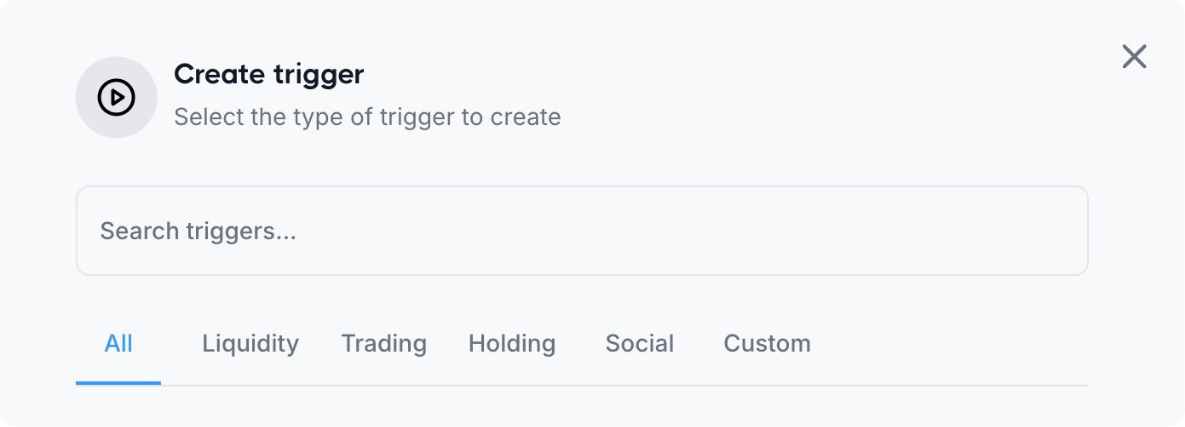
When you open the create-trigger page (or step 1 of onboarding), Fuul shows two options by default:
| Trigger | What it is |
| ------------------ | ---------------------------------------------------------------- |
| **API** | Any action you report from your own backend through the Fuul API |
| **Stripe Payment** | A one-off payment on a linked Stripe Connect account |
Everything else sits behind the **Crypto & quest triggers** switch. Turn it on to reveal the full catalogue, the category tabs, and the search box.
{% hint style="info" %}
New trigger types are added behind the switch, so turn it on whenever you are looking for a protocol integration and don't see it.
{% endhint %}
{% hint style="warning" %}
**"API" is the new display name for what the platform calls Custom Offchain.** Only the label changed — the trigger type stored on your program, and anything you have already configured, is unaffected. Older docs and older screenshots may still say "Custom Offchain".
{% endhint %}
### **Types of Triggers in Fuul**
#### Liquidity Triggers
* **CLAMM LPs** — snapshots of concentrated liquidity positions on Uniswap V3 and V3-style DEXs → [CLAMM LPs](/core-concepts/trigger-integrations/clamm-lps-e.g.-uniswap-v3.md)
* **Constant LPs** — LP token balances on Uniswap V2 and V2-style DEXs → [Constant LPs](/core-concepts/trigger-integrations/constant-lps-e.g.-uniswap-v2.md)
#### Lending & Staking Triggers
* **Lending & Borrowing** — supply and borrow positions on Compound V3, Morpho, Morpho Vaults, Euler Vaults, and Euler V2 Looping → [Lending & Borrowing](/core-concepts/trigger-integrations/lending-and-borrowing.md)
* **Staking** — staked balances tracked via subgraphs or receipt tokens → [Staking](/core-concepts/trigger-integrations/staking.md)
* **Yield** — Pendle and Spectra YT and LP positions, Exponent (Solana) vault positions → [Yield (Pendle)](/core-concepts/trigger-integrations/yield-pendle.md)
#### Trading Triggers
* **Spot DEXs** — Sushiswap, Nado, Ambient → [Trading](/core-concepts/trigger-integrations/trading.md)
* **HyperLiquid Builder Codes** — perpetual trading volume, fees, PnL, and maker/taker split → [HyperLiquid](/core-concepts/trigger-integrations/hyperliquid.md)
* **Orderly Builder Trades** → [Orderly Network](/core-concepts/trigger-integrations/orderly.md)
* **Pacifica Builder Trades** → [Pacifica](/core-concepts/trigger-integrations/pacifica.md)
* **Prediction markets** — per-market trade volume on Polymarket → [Polymarket](/core-concepts/trigger-integrations/prediction-markets-polymarket.md)
#### Holding Triggers
* **Token Holders** — snapshots of balances for an ERC-20, LP token, NFT, or SPL token. Sources can be a token contract, a subgraph, or a Dune query → [Token Holders](/core-concepts/trigger-integrations/token-holders.md)
#### Social & Quest Triggers
These triggers reward users who engage with your community.
* **X (Twitter)** — follows, posts, likes, and reposts → [𝕏 (Twitter)](/core-concepts/trigger-integrations/quests-and-social/x-twitter.md)
* **Discord** — server membership, channel joins, and role assignment → [Discord](/core-concepts/trigger-integrations/quests-and-social/discord.md)
* **Galxe & Zealy** — campaign participation and quest completion → [Galxe & Zealy](/core-concepts/trigger-integrations/quests-and-social/galxe-zealy.md)
* **Github Activity** — contributions on a repository
#### Custom Triggers
* **Custom Onchain** — any smart contract event or function call, with optional parameter filters → [Custom Onchain Events](/core-concepts/trigger-integrations/custom-onchain-events.md)
* **API** (formerly Custom Offchain) — actions reported from your own backend, a CSV upload, or Zapier → [Custom Offchain Events](/core-concepts/trigger-integrations/custom-offchain-events.md)
* **Subgraph Balances** — use this when the value you want to reward, such as cumulative deposits, is not available at the transaction level
* **Stripe Payment** — a completed payment on a linked Stripe Connect account, delivered by webhook with no schedule
{% hint style="info" %}
For the full catalogue with configuration details per protocol, see [Trigger Integrations](/core-concepts/trigger-integrations.md).
{% endhint %}
{% embed url="" %}